The problem wasn't the funnel

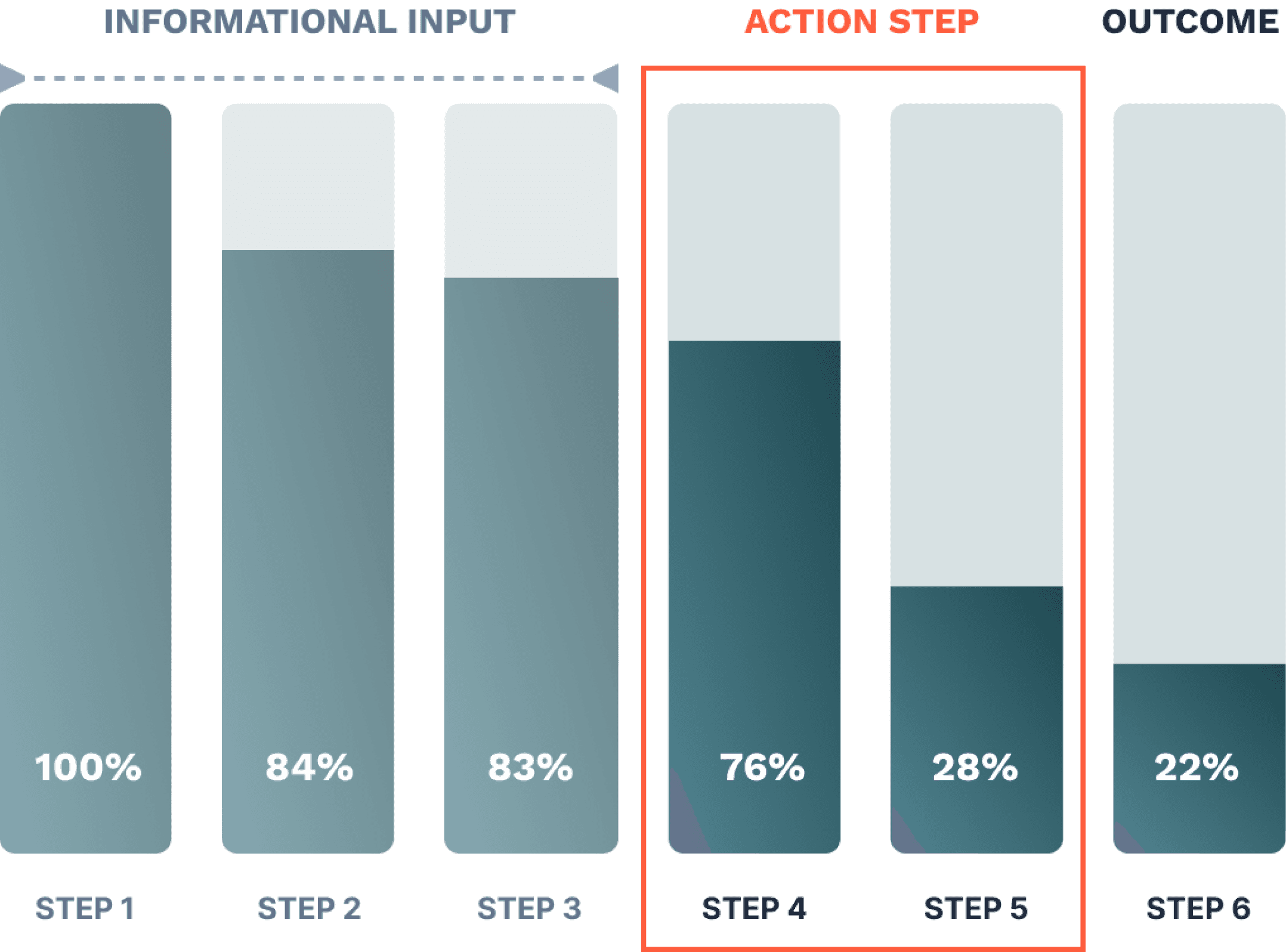
Coach-call conversion at Randstad RiseSmart sat at 22%, and enterprise clients were starting to question renewal. I was brought in to find where users were dropping and recommend fixes.

I started with the obvious hypothesis: friction. Optimizing the onboarding flow helped at the margins, but conversion barely moved. Following that failure upstream revealed the real problem: users didn't understand the service well enough to commit to it, in part because Product, Marketing, Sales, Coaching, and client communications were describing it differently.

The funnel restructure and landing page more than tripled conversion in the tracked funnel, from roughly 6% to 22%. For our strongest enterprise cohort, the funnel data showed conversion reaching as high as 51%.

My Role

Product Designer (research, UX, and cross-functional alignment)

Team

Product, Marketing, Sales, Coaching, Engineering, Data

Timeline

2022 to 2024

Focus

UX Research, Funnel Analysis, Information Architecture, Interaction Design, Cross-Functional Alignment

conversion across tracked funnel;
peak of 51% for strongest enterprise cohort

13 → 5 min

time to book first session

overview.

Randstad RiseSmart delivers career transition and workforce services to enterprise clients. Worklife Coaching connects employees with career coaches through 1:1 sessions, and enterprise contracts depended on employees actually engaging with the service.

The product was a year old and coach-call conversion sat at 22%. My initial charter was narrow: map the onboarding funnel, find where users dropped, and recommend fixes. It became a much larger question about what the service was and who was responsible for making that clear.

starting with the obvious answer.

When I started, users moved from an enrollment email through 2-3 forms into a dashboard crowded with competing CTAs, and few found their way to scheduling a coach call.

The dashboard was load-bearing and expensive to refactor, so I started with lower-cost interventions: simplify the forms, give coaching a defined place in the flow, and add context before users entered the product. If those changes worked, we could avoid a costly rebuild. If they didn't, we'd know the problem ran deeper before investing in one.

Consolidating onboarding steps helped at the margins, but conversion barely moved. That result ruled out the obvious answer without committing to a rebuild.

If tightening the funnel wasn't enough, I needed to look beyond the flow.

following the evidence.

01

Moving upstream of the funnel

The problem started even earlier: users went from an email invite directly into Terms of Service, with no explanation of what coaching was. Of 2,300 users who started onboarding, only 495 scheduled a call with a career coach.

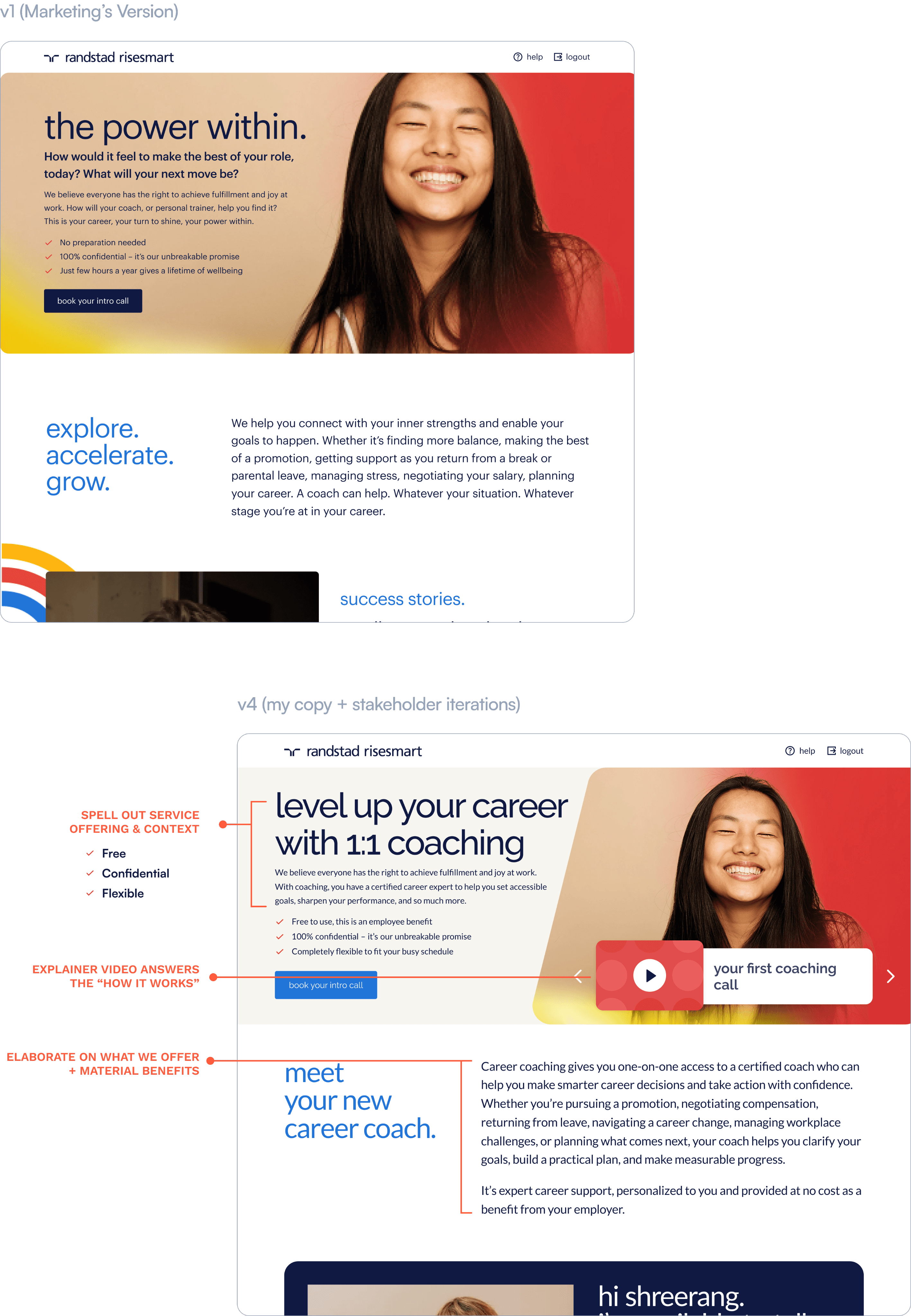
Marketing built a landing page to add that context, but FullStory showed users searching for information it didn't provide.

Pictured: First version of marketing page > my suggestion > final implementation

I tested a low-fidelity alternative with a look-a-like audience focused on plain-language explanations of the service, cost, and what to expect. Rather than clicks, I measured comprehension. The alternative performed measurably better on comprehension, giving Product the evidence to change the page and initiate more collaboration with marketing.

what it revealed

Clearer framing helped users understand the service, but conversion remained low. Something further downstream was still breaking.

02

Testing whether coach choice was the barrier

Hundreds of session recordings exposed two failures on the way to booking. (1) Users abandoned while choosing between coaches without a basis for deciding, and (2) those who did choose often reached calendars with no available times.

The availability problem had a no-design fix: stop surfacing coaches with no upcoming availability. I worked with Engineering to address the dead end at the data layer rather than designing an error state around it.

That left coach selection. A Randstad affiliate offered a useful comparison: its users were assigned a coach who reached out directly, bypassing formal onboarding. Interviews suggested the introduction reduced selection pressure and made the service feel more personal before users ever touched the product.

We A/B tested auto-assignment against coach selection. I designed the auto-assign experience, which Marketing polished. It helped, but only modestly, and that modest result was the signal that mattered: removing coach selection almost entirely still didn't fix conversion. Interviews also showed that without enough context, being handed a coach could feel confusing or suspicious.

what it revealed

Removing coach selection wasn't enough; Coach choice was part of the problem, but not the root cause. Users needed to understand what coaching was and why it was relevant before they would commit to it

the breakthrough.

Users didn't understand the service.

The earlier research built enough internal confidence to earn access to employees at one of our largest enterprise clients. Sales controlled how deeply we could research client organizations, so gaining that access was an important step in the process. Those interviews exposed something funnel analytics couldn't: users were entering the product with fundamentally different ideas about what RiseSmart and coaching were.

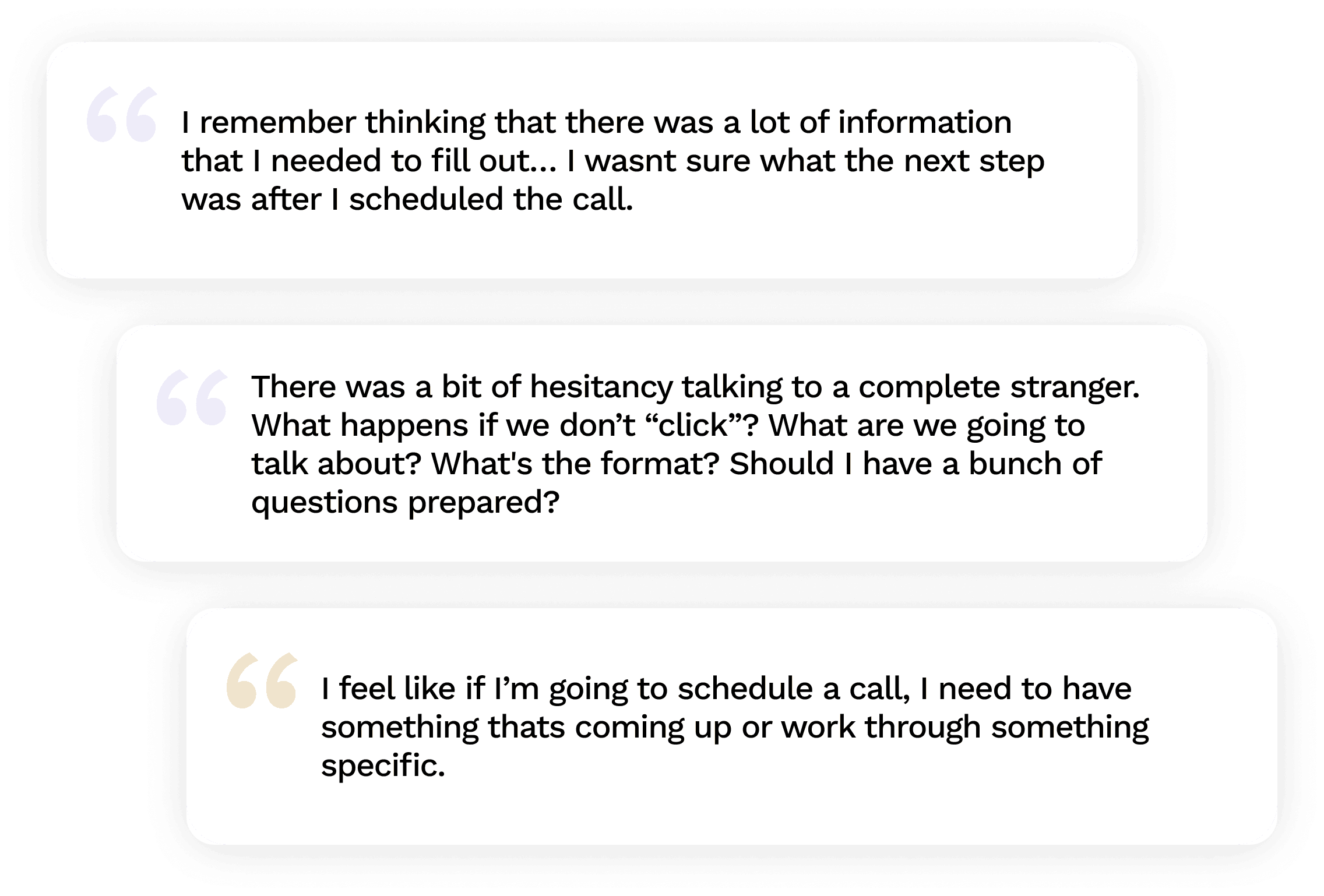
“What would I even talk about?”

Many users couldn't picture what happened in a coaching session or what they were supposed to bring to one.

“The first thing I started thinking was, what do I tell the coach? What relevant information do I need to give her to get the right feedback?”

“RiseSmart is for leaving my company.”

RiseSmart's legacy was outplacement, so in interviews some employees read coaching through that legacy, assuming it was for people leaving their jobs rather than developing within them.

“My perception of RiseSmart is outplacement services, so I didn't use it because I wasn't looking to leave my company.”

“Which service comes first?”

For clients that bundled coaching with resume services, the offerings blurred together. In interviews, we heard users who believed they had to complete their resume before talking to a coach, and others who believed coaching had to happen first. Neither was true.

The clearest evidence came during a screenshare: one client's benefits portal described RiseSmart as resume writing.

Users were arriving with the wrong expectation before our product ever loaded.
The problem I'd been chasing through the funnel lived outside the funnel.

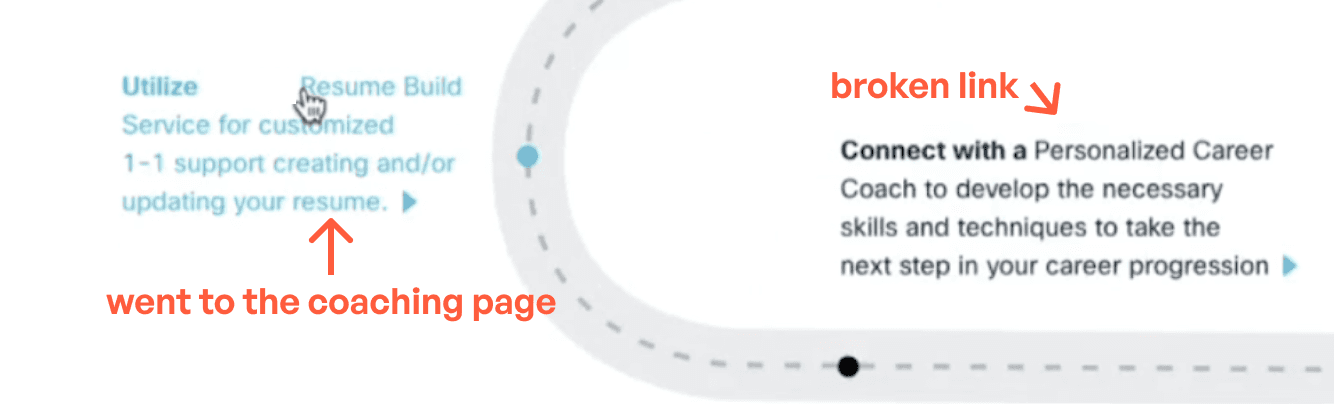
broken link

went to the coaching page

At one enterprise client, the benefits portal's resume link opened the coaching page, and the coaching link was broken. The two bundled services were crossed and broken before our product ever loaded.

designing for service legibility.

The research pointed to two levels of intervention: make coaching easier to understand inside the experience, then address the inconsistent framing creating confusion upstream.

01

Make coaching concrete

To close the “what would I even talk about?” gap, the VP of Product initiated a coaching library organized around topics coaches could help with, each supported by a short video from a real coach.

The interview findings helped shape the topics, and I owned the library UI and interactive elements. Users could explore coaching through concrete scenarios before committing to a session, while reassurance about cost and confidentiality appeared at the moments those concerns were most likely to arise.

My team also took ownership of the landing page, allowing me to continue iterating on how the service was explained before users entered onboarding.

But clarity inside the product could only go so far while the framing outside it remained inconsistent.

02

Fixing the problem beyond the product

Interviews showed that Sales, Marketing, Product, and Coaching each held a different working definition of what coaching was, who it served, and what to promise. Users arrived with expectations shaped by whichever team or client communication reached them first.

I brought that evidence to the wider organization and proposed cross-functional alignment as a design priority. At Randstad's scale, teams needed material proof before acting, so each research presentation became a tool for earning the next level of access and buy-in.

My design manager facilitated workshops across all four teams to establish a shared definition of the service, something that hadn't been done at the RiseSmart and Randstad level. That definition became the basis for revised onboarding messaging and a quarterly cross-team review that continued after the project.

The landing page, coaching library, and auto-assignment improved clarity inside the product. The alignment work addressed the source of the confusion so those improvements could hold.

outcomes.

Coach-call conversion more than doubled, from roughly 22% to 51%.

The interventions measurably lifted conversion. In the tracked funnel, conversion more than tripled, from roughly 6% to 22%, after the funnel restructure and landing page. For our strongest enterprise cohort, the funnel data showed it reaching as high as 51%. The gains were cumulative: no single change produced them. Auto-assignment, the coaching library, clearer landing-page copy, and consistent cross-team messaging each contributed as they compounded.

Time to book a first session: 13 minutes → 5mins

The restructured flow more than halved the time it took a user to get from entry to booking a call, a figure I tracked directly through the project.

2× activation among new enterprise users.

Higher enterprise engagement. The cohorts I worked with directly, and new ones onboarded after the positioning work with Coaching and Sales, engaged at higher rates than in the prior year.

A quarterly cross-functional review.

Across Sales, Marketing, Product, and Coaching continued after the project and reduced enterprise rollout friction.

Qualitatively, users reported understanding coaching's value before their first session, coaches reported participants arriving more prepared and goal-oriented, and inbound questions about cost, confidentiality, and coach choice dropped.

attribution.

What I owned

Funnel research and analysis, pre-landing-page onboarding UX and flow optimization, the comprehension A/B test and winning copy, coaching library UI and interactions, every iteration of the landing page once my team took it over, and the stakeholder research presentations that unlocked deeper access at each stage.

What I contributed to

The coaching library, a concept the VP of Product originated and staffed with a coaching content team, with topics shaped by my interview findings; and the cross-team alignment workshops, which I proposed and my design manager facilitated.

What others owned

Sales owned access to enterprise cohorts and determined how deeply we could research client organizations. Marketing owned branding and the first landing page. Coaching produced the video content. Engineering owned scheduling and availability infrastructure.

key learnings.

A modest result can be the most useful one.

Auto-assignment improved conversion but didn't solve it. That result ruled out coach selection as the root cause and pointed the diagnosis toward comprehension.

For bundled services, legibility is part of the product.

When coaching shipped alongside resume and outplacement services, users couldn't tell the offerings apart or how they related. Making the service understandable mattered more than optimizing any single screen.

Cross-functional alignment is a product problem.

Inconsistent framing across Sales, Marketing, Product, and Coaching directly undermined activation. Sustainable improvement required fixing both the experience and the system shaping expectations around it.