Randstad Risesmart

Randstad Risesmart

·

Product Designer

Product Designer

·

2022 - 2024

2022 - 2024

Rebuilding Trust at the Front Door

Rebuilding Trust at the Front Door

A landing page proposal forced Sales, Marketing, Product, and Coaching to agree on what the service actually was — the alignment adoption depended on.

A landing page proposal forced Sales, Marketing, Product, and Coaching to agree on what the service actually was — the alignment adoption depended on.

22%

50%

Coach-call conversion

2×

Activation increase

30-40%

Onboarding drop-off

01

Business Context

Randstad RiseSmart delivers career transition and workforce development services to enterprise clients globally. The Worklife Coaching product connects employees with specialized career coaches through 1:1 sessions. The business model depended on employees actively booking calls — each enterprise contract renewed based on whether they did.

Coach-call conversion sat at 22%. The product was one year old. Enterprise clients were beginning to question renewal.

Randstad RiseSmart delivers career transition and workforce development services to enterprise clients globally. The Worklife Coaching product connects employees with specialized career coaches through 1:1 sessions. The business model depended on employees actively booking calls — each enterprise contract renewed based on whether they did.

Coach-call conversion sat at 22%. The product was one year old. Enterprise clients were beginning to question renewal.

02

Problem & Goals

The assumption entering this project was a usability problem. It was not.

Users arrived without enough context to trust the service or commit to a first call. They did not know what coaching was, whether it was free, or whether their participation was confidential. They were asked to choose a coach before understanding what a coach does.

No UI improvement addresses a clarity and expectation problem.

The assumption entering this project was a usability problem. It was not.

Users arrived without enough context to trust the service or commit to a first call. They did not know what coaching was, whether it was free, or whether their participation was confidential. They were asked to choose a coach before understanding what a coach does.

No UI improvement addresses a clarity and expectation problem.

The assumption entering this project was a usability problem. It was not.

Users arrived without enough context to trust the service or commit to a first call. They did not know what coaching was, whether it was free, or whether their participation was confidential. They were asked to choose a coach before understanding what a coach does.

No UI improvement addresses a clarity and expectation problem.

product + ux Goals

Reduce drop-off and increase coach-call bookings

Build trust and forward momentum for first-time users

Align cross-functional teams on service messaging

Position coaching as a career development benefit, not an HR add-on

Support enterprise contract renewals through improved adoption

Reduce drop-off and increase coach-call bookings

Build trust and forward momentum for first-time users

Align cross-functional teams on service messaging

Position coaching as a career development benefit, not an HR add-on

Support enterprise contract renewals through improved adoption

Success Metrics

Activation: first-time users who schedule a coach call

Speed to value: time from registration to first scheduled session

Funnel health: onboarding drop-off and stage-by-stage progression

Engagement quality: first coaching milestone reached

03

Research & insights

Rather than auditing the UI first, I mapped the full experience ecosystem to understand where expectations were being set and where they were breaking down. The research happened in phases, each one feeding directly into the next intervention.

Rather than auditing the UI first, I mapped the full experience ecosystem to understand where expectations were being set and where they were breaking down. The research happened in phases, each one feeding directly into the next intervention.

Phase 1

Behavioral Analysis

Reviewing 300+ FullStory session recordings showed most users exiting at "Pick a Coach" after scanning profiles without committing. Interest was present. A basis for choosing was not. Users who made it to scheduling frequently hit coaches with no available times and left with no recovery path — at the moment of highest intent.

Reviewing 300+ FullStory session recordings showed most users exiting at "Pick a Coach" after scanning profiles without committing. Interest was present. A basis for choosing was not. Users who made it to scheduling frequently hit coaches with no available times and left with no recovery path — at the moment of highest intent.

2.3k Users

1.9k Users

713 Users

495 Users

135 Users

Terms & Conditions Viewed

Onboarding Funnel Drop-Off (Pre-Landing Page)

0%

20%

40%

60%

80%

100%

Onboarding Started

Coach List Viewed

‘Schedule a Call’ Clicked

Call Scheduled

The more significant finding was structural. The original flow took users from an email invite into a Terms of Service page before the service had been described. Six steps to the dashboard, none of which explained what they were signing up for.

The more significant finding was structural. The original flow took users from an email invite into a Terms of Service page before the service had been described. Six steps to the dashboard, none of which explained what they were signing up for.

phase 2

Landing Page Iteration

I presented the findings and recommended a landing page to anchor the experience upfront. Marketing built the first version. FullStory showed users scrolling repeatedly, looking for more information that wasn't there. I proposed an FAQ. Users went straight to it, which confirmed they wanted a plain explanation of what the service was. Most still left, but the behavior was diagnostic.

I presented the findings and recommended a landing page to anchor the experience upfront. Marketing built the first version. FullStory showed users scrolling repeatedly, looking for more information that wasn't there. I proposed an FAQ. Users went straight to it, which confirmed they wanted a plain explanation of what the service was. Most still left, but the behavior was diagnostic.

I wrote alternative copy that explained the service upfront and stated explicitly that it was free. We A/B tested it against the marketing version with a recruited look-alike audience.

My version produced significantly deeper comprehension. When we presented the results, product design gained full landing page ownership without marketing approval, enabling faster iteration and the credibility to access enterprise users for the first time.

I wrote alternative copy that explained the service upfront and stated explicitly that it was free. We A/B tested it against the marketing version with a recruited look-alike audience.

My version produced significantly deeper comprehension. When we presented the results, product design gained full landing page ownership without marketing approval, enabling faster iteration and the credibility to access enterprise users for the first time.

Phase 3

Monster Employee Interviews — Cohort 1

Monster was an existing Randstad affiliate whose employees had been onboarded differently: a coach was pre-assigned and reached out proactively to introduce themselves and schedule a first call. Their conversion rate was nearly double the baseline. Ten interviews from 16 outreaches told us why.

Having a coach reach out first had humanized the service before users ever touched the product. No sign-up friction, no selection pressure, no scheduling dead end. Nobody wanted to switch coaches. Most didn't know they could. This gave us the hypothesis: assign coaches rather than ask users to select them.

Having a coach reach out first had humanized the service before users ever touched the product. No sign-up friction, no selection pressure, no scheduling dead end. Nobody wanted to switch coaches. Most didn't know they could. This gave us the hypothesis: assign coaches rather than ask users to select them.

Enterprise Client Interviews — Cohort 2

The Monster cohort opened access to a larger enterprise research engagement. I coordinated approvals with Sales, wrote scripts for an international audience, and secured 28 interviews from 62 outreaches.

The Monster cohort opened access to a larger enterprise research engagement. I coordinated approvals with Sales, wrote scripts for an international audience, and secured 28 interviews from 62 outreaches.

This cohort surfaced a different problem: many users assumed the service cost their employer money, associated coaching with performance improvement plans, or could not see how a generalist coach applied to their specialized role. None of this was addressed anywhere in the product. These were rational interpretations of a service that had never said otherwise.

This cohort surfaced a different problem: many users assumed the service cost their employer money, associated coaching with performance improvement plans, or could not see how a generalist coach applied to their specialized role. None of this was addressed anywhere in the product. These were rational interpretations of a service that had never said otherwise.

This cohort surfaced a different problem: many users assumed the service cost their employer money, associated coaching with performance improvement plans, or could not see how a generalist coach applied to their specialized role. None of this was addressed anywhere in the product. These were rational interpretations of a service that had never said otherwise.

Coach Interviews — Cohort 3

Career coach interviews identified the topics they covered most in sessions — giving us concrete material to make the value proposition legible rather than abstract. The categories coaches named most frequently became the organizing structure for a coaching topic library I designed in partnership with the coaching team.

Career coach interviews identified the topics they covered most in sessions — giving us concrete material to make the value proposition legible rather than abstract. The categories coaches named most frequently became the organizing structure for a coaching topic library I designed in partnership with the coaching team.

01

Clarity

Users didn't know what coaching was

Most participants entered onboarding without a working mental model of career coaching. "Is this therapy?" "Is this job placement?" "Why is my employer offering this?" were common reframings. Without clarity on what the service was, commitment to a first call felt premature.

Most participants entered onboarding without a working mental model of career coaching. "Is this therapy?" "Is this job placement?" "Why is my employer offering this?" were common reframings. Without clarity on what the service was, commitment to a first call felt premature.

02

Decision Fatigue

The flow asked users to make a high-effort decision before they had enough context to make it

Coach selection appeared early in the journey before users understood what coaching was or what they'd be selecting for. Faced with a grid of profiles and no evaluative framework, most users browsed briefly and left.

Coach selection appeared early in the journey before users understood what coaching was or what they'd be selecting for. Faced with a grid of profiles and no evaluative framework, most users browsed briefly and left.

03

Momentum

Scheduling dead ends destroyed momentum at the worst possible moment.

Users who made it through coach selection often hit a calendar with no available times, with no alternative path offered. They had to start over or abandon entirely — at the exact moment they'd decided to commit.

Users who made it through coach selection often hit a calendar with no available times, with no alternative path offered. They had to start over or abandon entirely — at the exact moment they'd decided to commit.

04

Trust

Enterprise users had specific trust concerns that weren't being addressed.

Privacy and confidentiality concerns were significant. Many users worried whether their participation would be visible to managers or HR. In an enterprise context, this concern is rational and needed to be addressed explicitly — not assumed away.

Privacy and confidentiality concerns were significant. Many users worried whether their participation would be visible to managers or HR. In an enterprise context, this concern is rational and needed to be addressed explicitly — not assumed away.

05

Systems Thinking

Internal messaging inconsistency was upstream of every UX problem.

Stakeholder workshops surfaced that Sales, Marketing, Product, and coaches each had different working definitions of what the service was, who it served, and what outcomes to promise. Whatever fix we applied to the onboarding flow would be undermined if users arrived with mismatched expectations.

Stakeholder workshops surfaced that Sales, Marketing, Product, and coaches each had different working definitions of what the service was, who it served, and what outcomes to promise. Whatever fix we applied to the onboarding flow would be undermined if users arrived with mismatched expectations.

04

Constraints

Enterprise governance.
Changes required legal review, cross-functional planning, and staged rollouts across enterprise contracts.

Enterprise governance.
Changes required legal review, cross-functional planning, and staged rollouts across enterprise contracts.

Organizational silos.
Teams were segmented across departments, constraining access to user data and client contacts before research could begin.

Organizational silos.
Teams were segmented across departments, constraining access to user data and client contacts before research could begin.

Global user base.
Copy had to be concise and translation-ready across markets.

Global user base.
Copy had to be concise and translation-ready across markets.

Incremental releases.
The scale of Randstad's infrastructure meant staged testing — a constraint that also enabled A/B testing and controlled iteration throughout.

Incremental releases.
The scale of Randstad's infrastructure meant staged testing — a constraint that also enabled A/B testing and controlled iteration throughout.

05

Strategic Decisions

Decision 01

Move coach selection out of the critical path

The first and cheapest intervention was a sequencing change: remove coach selection from the onboarding flow and drop users directly into the dashboard, with a prominent CTA banner as the single entry point to coaching. The hypothesis was that users were abandoning during coach selection because they lacked product context, not because they lacked intent.

Why this choice

Getting users into the product before asking for a high-trust decision would reduce selection friction and surface what actually mattered to them first.

System impact

More users made it through onboarding. But FullStory showed most went straight to "complete my profile" and ignored the coach banner entirely. The banner was visible. Users just had no reason to treat coaching as the priority. The problem wasn't sequencing — it was upstream. Users needed context before they ever touched the product.

Decision 02

Add a value-setting landing page

The dashboard-first test confirmed users weren't avoiding coach selection out of friction — they were deprioritizing it because nothing had explained why coaching was the point of the product. The next intervention moved upstream: a dedicated landing page before the flow began.
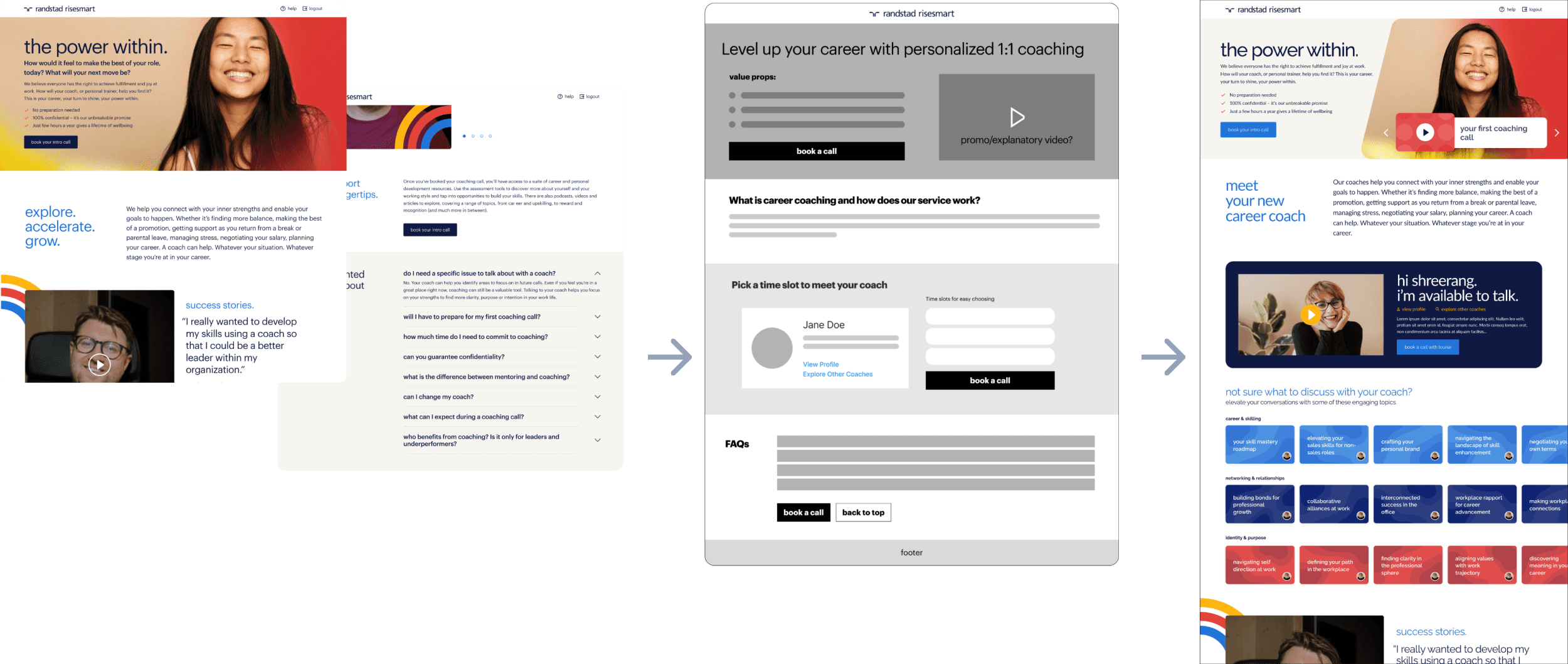
Three rounds of iteration shaped the solution — from a brand-forward marketing version users scrolled past, to FAQ testing that confirmed users wanted a plain explanation of the service, to copy I wrote that explained the service upfront and stated explicitly that it was free. We A/B tested it against the marketing version. My version produced significantly deeper comprehension.

Three rounds of iteration shaped the solution — from a brand-forward marketing version users scrolled past, to FAQ testing that confirmed users wanted a plain explanation of the service, to copy I wrote that explained the service upfront and stated explicitly that it was free. We A/B tested it against the marketing version. My version produced significantly deeper comprehension.

Why this choice

The funnel was asking for commitment before offering any reason to give it. Inserting a product-owned page at the top meant controlling the baseline rather than patching leaks downstream.

System impact

Product owned the first language users encountered. The landing page also became the first artifact both Product and Marketing co-owned, opening a working relationship that later supported cross-functional alignment.

Product owned the first language users encountered. The landing page also became the first artifact both Product and Marketing co-owned, opening a working relationship that later supported cross-functional alignment.

Decision 03

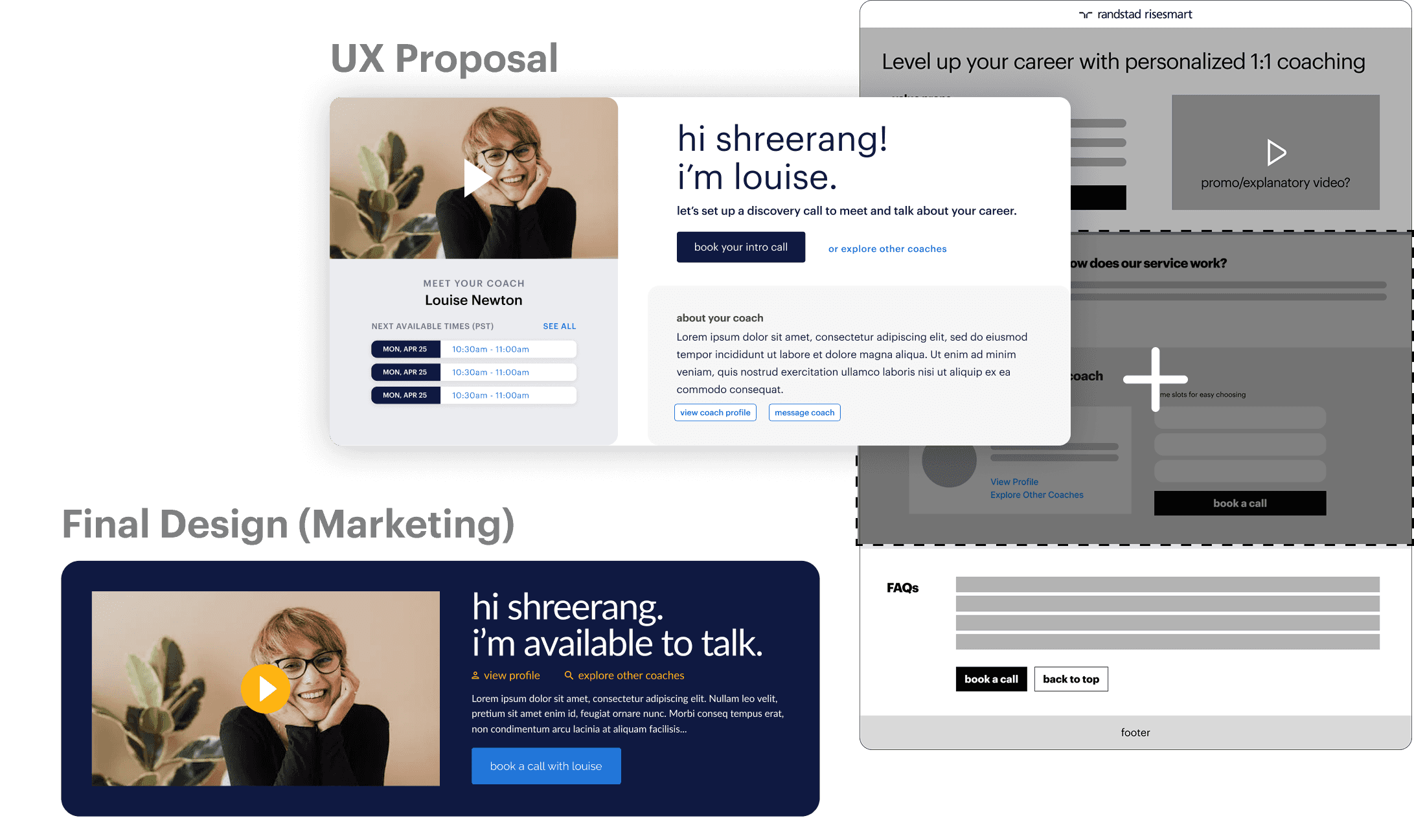
Auto-assign an initial coach rather than require active selection

The Monster cohort had nearly double the baseline conversion rate. Their coach reached out first — before users ever touched the product. FullStory had already shown that standard users browsed profiles and engaged with bios before leaving. Interest was present. A basis for choosing was not.
Why this choice

Auto-assignment reframed the experience from "choose the right coach" to "start coaching." Switching was surfaced as a natural option after a first session, making it feel like a next step rather than a correction.

System impact

When users lack context, reducing choice builds confidence faster than expanding it. Coaches also benefited — participants arrived with momentum rather than uncertainty, and first sessions were more goal-oriented as a result.

Decision 04

Make coaching legible before asking users to commit

The most consistent finding across all three interview cohorts and surveys was not just about cost or privacy. It was that users had no idea what they would talk to a coach about. Without a concrete sense of what a session looked like, scheduling felt abstract and low-priority.

Cost and confidentiality concerns compounded the hesitation as many users assumed the service cost their employer money, and many associated coaching with performance improvement plans. The deeper barrier was a knowledge gap, not a trust gap.

Rationale

Two categories of concern needed to be addressed simultaneously: the "what" (what does coaching actually look like) and the "whether" (is this free, is this appropriate for me). Product partnered with the coaching team to design a video library organized by coaching topics.
Each video was produced by a coach to explore a common topic and provide concrete examples. I designed the library UI and shaped the functionality, including topic bookmarking so users could flag areas to discuss before their first call. Explicit reassurance messaging in the flow handled the cost and confidentiality concerns directly, surfaced at the moment each concern was most likely to arise.

System impact

Coaches reported participants arriving to first sessions with more context and specific goals, anecdotally within weeks of launch. The library gave users a path into coaching through curiosity rather than commitment, and reduced inbound questions around cost, confidentiality, and what to expect.

Decision 05

Prevent scheduling dead ends at the infrastructure level

Users who completed onboarding and were ready to book frequently hit coaches with no available times. The flow surfaced coaches regardless of availability. With no recovery path, users left at the moment of highest intent.

Why this choice

A UI state that says "no times available" is the wrong answer. The right answer is that the condition should not exist. I worked with engineering to filter coach visibility by actual availability — a data layer change, not a new screen state.

System impact

This established a working principle for the rest of the project: if a UI error message is the answer, ask whether the error needs to exist at all. It also strengthened the design-engineering relationship — once we had collaborated at the infrastructure level, similar interventions moved faster.

06

Cross-Functional Collaboration

Users arrived with expectations shaped by Sales emails and Marketing campaigns I had no direct control over. Whatever clarity we built inside the product could be undermined by misaligned messaging outside of it.

I identified the gap and proposed cross-functional alignment as a design priority. My design manager facilitated the stakeholder workshops with Product, Marketing, Sales, and the Coaching team to establish a shared definition of the service. This had not been done before at the RiseSmart and Randstad level. It became the foundation for revised onboarding messaging and a quarterly cross-team review process that continued after the project closed.

Users arrived with expectations shaped by Sales emails and Marketing campaigns I had no direct control over. Whatever clarity we built inside the product could be undermined by misaligned messaging outside of it.

I identified the gap and proposed cross-functional alignment as a design priority. My design manager facilitated the stakeholder workshops with Product, Marketing, Sales, and the Coaching team to establish a shared definition of the service. This had not been done before at the RiseSmart and Randstad level. It became the foundation for revised onboarding messaging and a quarterly cross-team review process that continued after the project closed.

MARKETING

Landing page UI

Branding assets

Copywriting

Landing page UI

Branding assets

Copywriting

Product

Usage data

Funnel mapping

Implementation

Usage data

Funnel mapping

Implementation

Design

Info Architecture

User interviews

Surveys

AB Testing

Info Architecture

User interviews

Surveys

AB Testing

Sales

Client outreach for research

Coordination with Legal

Client outreach for research

Coordination w/ Legal

Client outreach for research

Coordination w/ Legal

coaching

Service context

Video media for content library

Service context

Video media for content library

07

Outcomes

Quantitative

Call conversion: 22% → 51%

Time to first session:
13 min → 6 min

Drop-off reduced 30–40%

activation among new enterprise users

Qualitative

Users reported clearer understanding of coaching value before their first session

Coaches reported participants arriving more prepared and goal-oriented

Fewer inbound questions around cost, confidentiality, and how to choose a coach

Organizational

Introduced a quarterly cross-functional review process across Sales, Marketing, Product, and Coaching

Improved transparency across teams reduced enterprise rollout friction

08

Key Learnings

Reducing early choices builds confidence

Reducing early choices builds confidence

When users lack context, auto-assignment and simplified flows consistently outperformed approaches that asked users to decide first and understand later.

Clarity drives conversion more reliably than polish.

Clarity drives conversion more reliably than polish.

Users commit when they understand the value, not when the UI looks clean. The most impactful changes in this project were copy and sequencing decisions.

Low conversion is often a trust and expectation problem.

Low conversion is often a trust and expectation problem.

Auditing the UI first would have produced surface-level fixes. Mapping the full experience ecosystem identified where expectations were actually breaking.

Cross-functional alignment is a product problem.

Cross-functional alignment is a product problem.

For service-based products, inconsistent messaging across teams directly impacts activation. Aligning on a shared definition of the service was as impactful as any design change.

Infrastructure is part of the design surface.

Infrastructure is part of the design surface.

If a UI error message is the answer, ask whether the error needs to exist at all.

Previous case study

Next case study